Understand every idea, then say it in Vietnamese: Hệ 1 → Hệ 2 → Người quyết định
Explanations are in English. Vietnamese terms are in green quotes. Gold boxes marked NÓI THẾ NÀY give the exact Vietnamese sentences to say on stage. Every number carries its source and a confidence tag: H primary text read, M secondary or partial, L unverified.
Alerts work only when someone is responsible for acting on them
Satellites already see forest change. Around the world, alerts cut deforestation when a party has responsibility, capacity and a deadline to act (subscribing organisations, paid patrols, IBAMA fines). Having the alerts available does nothing on its own. AI makes the screening fast and builds a file with sources. It does not replace the authority of the person who decides.
Hệ 1 · sàng lọc
A fast, cheap, narrow model scores every pixel. It outputs a risk score, never a conclusion. Like the reflex of an experienced ranger: "this spot looks odd".
Hệ 2 · lập hồ sơ có dẫn nguồn
An LLM agent reads only the few flagged cases, joins them with records (lô rừng, phương án, bảng kê) and drafts a file where every claim has a source.
Người có thẩm quyền quyết định
The kiểm lâm địa bàn reviews and reports (TT 26/2025 Đ16 k5); the Hạt trưởng returns the draft or decides the unscheduled inspection, and remains responsible. This is Luật TTNT 134/2025 Đ4 k2 and Đ27 k2.
Why a law audience cares
- The hook is legal, not technical. An AI alert is thông tin về dấu hiệu vi phạm, a ground for an unscheduled inspection (TT 26/2025 Đ16 k4), never evidence. Evidence is the field record (biên bản kiểm tra).
- The texts are new. Luật TTNT (in force 1/3/2026), NĐ 146/2026 (25/6/2026), TT 26/2025 (1/7/2025), EUDR (30/12/2026). Getting these right is how you earn the room in the first minute.
- The open questions are theirs to answer. Who is the bên triển khai? What goes into the Đ27 k3 impact report? Must thresholds be published? We bring data; the faculty brings legal design.
Kinh nghiệm thế giới cho thấy cảnh báo vệ tinh chỉ giúp giảm phá rừng khi gắn với một chủ thể có trách nhiệm, năng lực và thời hạn hành động. Chỉ có dữ liệu thôi thì chưa đủ.
Hôm nay tôi đề xuất chia việc thành ba tầng. Hệ 1 sàng lọc hàng triệu điểm ảnh trong vài giây. Hệ 2 lập hồ sơ có dẫn nguồn cho số ít trường hợp đáng xem. Và người có thẩm quyền quyết định, đúng tinh thần Điều 4 khoản 2 Luật Trí tuệ nhân tạo: AI không thay thế thẩm quyền và trách nhiệm của con người.
Đầu ra của AI là căn cứ để kiểm tra, không phải kết luận vi phạm.
Ten ideas behind the slides, each with something to play with
You do not need to be a remote-sensing or ML expert. You need to be able to explain each idea in two sentences and to know where it breaks.
Sentinel-2 sees colours your eye cannot
Sentinel-2 is the EU's free optical satellite pair. It photographs the land roughly every 5 days (if there is no cloud), and the sharpest bands have 10 m pixels: one pixel = 10 × 10 m = 100 m². So 1 ha = 100 pixels, and Vietnam's 14.971.553 ha of forest ≈ 1,5 billion pixels.
Each pixel is recorded in several bands (kênh phổ), slices of light. The demo uses six: blue B02, green B03, red B04 and near-infrared B08 at 10 m, and two short-wave infrared bands B11 and B12 at 20 m (resampled to 10 m). Healthy leaves reflect a lot of near-infrared (NIR), which our eyes cannot see. Bare soil and dry wood reflect a lot of short-wave infrared (SWIR). That is why "false-colour" images make clearings jump out.
Vệ tinh Sentinel-2 của châu Âu chụp miễn phí, khoảng 5 ngày một lần nếu trời không mây, mỗi điểm ảnh là một ô 10 nhân 10 mét. Ngoài màu mắt thường thấy, nó ghi cả ánh sáng hồng ngoại, nơi lá cây khỏe và đất trống khác nhau rất rõ.
Sources: data/out/README.md (scene IDs, bands, cloud) H · Bình Thuận processing "every 5 days" (proven_solutions #15) M · critique_tech §1.1 "wrong target" H
Two ratios that turn colours into "how green" and "how burnt or bare"
NDVI (chỉ số thực vật) compares NIR with red. Leaves absorb red and reflect NIR, so dense vegetation gives a high NDVI (≈0,8+), bare soil a low one (≈0,1–0,2), water a negative one. NBR (Normalized Burn Ratio) compares NIR with SWIR (B12); it drops sharply when vegetation is replaced by bare soil, ash or dry wood. The demo also uses NDMI (NIR vs B11, moisture).
A change detector compares the same pixel at two dates: ΔNDVI = NDVIafter − NDVIbefore. A strong negative ΔNDVI suggests vegetation was removed.
NDVI là chỉ số thực vật: so sánh ánh sáng hồng ngoại với ánh sáng đỏ. Rừng rậm cho NDVI khoảng 0,8; đất trống chỉ khoảng 0,1 đến 0,2. Khi NDVI của cùng một điểm giảm mạnh giữa hai thời điểm, đó là dấu hiệu lớp phủ đã thay đổi, chưa phải bằng chứng ai đã chặt.
Sources: demo_summary.json top20 (DG-001) H · tier rule in alerts_summary.json H · critique_tech §3.2(b) regrowth H · model_metrics.json baseline H
"Tree-cover loss" ≠ deforestation
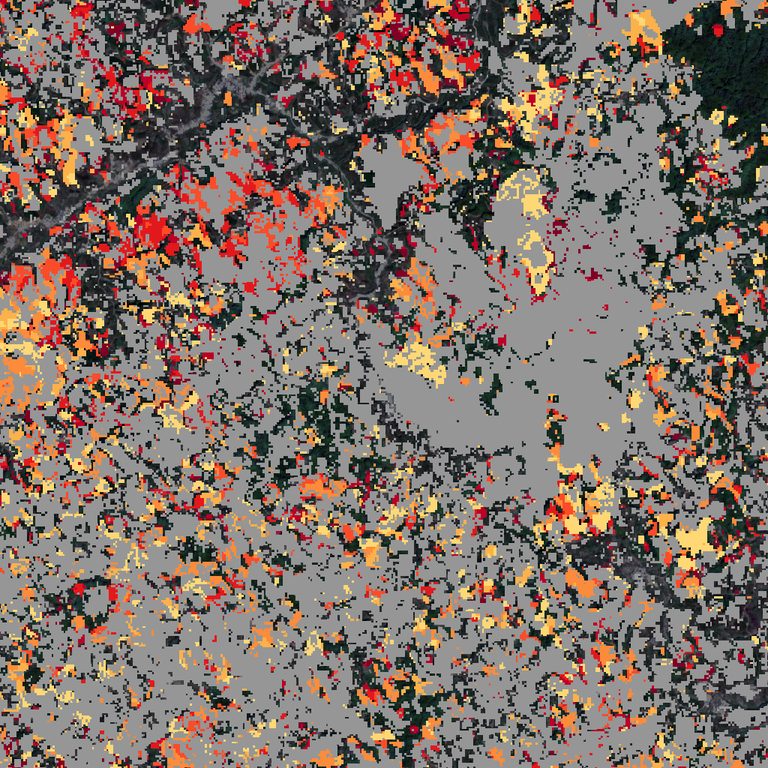
Hansen Global Forest Change (University of Maryland, Hansen et al. 2013, Science) maps, every year since 2001, where tree cover taller than 5 m was removed, at 30 m resolution from Landsat. Global Forest Watch (GFW) shows these maps. The demo uses version v1.13 (loss up to 2025) as its labels.
The catch: "tree cover" includes plantations, and "loss" includes any stand-replacing removal. In Vietnam, acacia and eucalyptus are harvested on 5–7 year rotations and replanted. Each harvest is "loss" for Hansen, while the official forest stock barely changes. So GFW shows 3.805.663 ha of tree-cover loss in Vietnam for 2001–2025 (47,1% attributed to logging/forestry), while official forest cover stays at 42,03%. Both are true: one measures gross canopy removal, the other the stock.
The national number that hides a loss
QĐ 1106 (31/3/2026): forest cover 42,03%, the same as 2024. But inside it, natural forest fell 54.586 ha while planted forest rose 151.837 ha. A hectare of acacia does not replace a hectare of natural forest, and QĐ 1106 Đ2 k2(c) itself orders provinces with natural-forest decline to find the causes and who is responsible.
"Mất tán cây" trên Global Forest Watch không đồng nghĩa với phá rừng. Mỗi lần khai thác keo theo chu kỳ 5 đến 7 năm đều bị tính là mất tán cây, rồi rừng được trồng lại. Vì vậy con số 42,03% ổn định và con số mất tán cây rất lớn không mâu thuẫn nhau. Con số đáng lo nằm trong chính Quyết định 1106: năm 2025, rừng tự nhiên giảm 54.586 ha.
Sources: QĐ 1106 PDF H · GFW workbook v20260427 xlsx H · 5–7 year rotations (factcheck #20) H · Hansen v1.13 download H
Fast screening, slow reasoning, human decision
Kahneman: only an analogy
In Thinking, Fast and Slow, Daniel Kahneman describes "System 1" (fast, intuitive) and "System 2" (slow, deliberate) thinking. It is a metaphor, and dual-process theory is itself debated in psychology. Never say AI "thinks like a brain".
LeCun: Mode-1 and Mode-2
Yann LeCun's 2022 paper A Path Towards Autonomous Machine Intelligence splits an agent into a fast reactive Mode-1 and a slow Mode-2 planner with a world model. Mode-2 results can be distilled back into Mode-1. That is our feedback loop: ranger verdicts become training labels for Hệ 1. JEPA models (V-JEPA 2, 2.1) are encoders, intellectual background only, not a product called "System 1".
"Decision models" and Jev
The boss's "Jet" is almost certainly Jev, from TypeSafe AI, launched in early access on 15/9/2026 as "the first System One Model" (a vendor claim, with an open prior-art dispute). It answers typed questions with probabilities in one pass, without generating text. Closed weights, US-hosted. OpenAI, Perplexity and others released similar "decision" services within weeks.
The one independent test: Vals AI (6/10/2026)
On claim-checking of 400 10-K items, Jev tied with frontier LLMs (97,5%). On a LegalBench slice (396 questions) it came last of 12 (0,730 vs 0,932), with the worst calibration. A threshold frozen on 30% of the data overshot its 1% error budget (1,6%). Lesson: System 1 for screening, never for legal judgement.
Mô hình Hệ 1 giống phản xạ của một kiểm lâm lâu năm: nhìn hàng triệu điểm ảnh trong tích tắc và chỉ ra "chỗ này đáng ngờ". Nó không kết luận vi phạm. Nó chỉ quyết định cái gì cần Hệ 2 và con người xem kỹ.
Một đánh giá độc lập gần đây cho thấy loại mô hình nhanh này ngang các mô hình lớn khi kiểm tra thông tin, nhưng xếp cuối khi làm suy luận pháp lý. Vì vậy: Hệ 1 để sàng lọc, không bao giờ để kết luận pháp lý.
Sources: system1.md §1–2 H · Vals AI blog H · TypeSafe launch post (vendor claims) · critique_tech §1.4–1.5 H
Hundreds of small yes/no questionnaires that vote
A decision tree is a flowchart of yes/no questions ("did NDVI drop by more than 0,1?", "did SWIR rise?"). One tree is weak. Gradient boosting builds trees one after another, each new tree correcting the mistakes of the ones before; the final score is the sum of all trees, squashed to 0–1. LightGBM is a fast, open-source implementation (Microsoft, 2017 era) that runs well on an ordinary CPU.
The demo model: 400 trees, up to 63 leaves each, 32 features per pixel (6 bands × 2 dates, NDVI/NBR/NDMI, their changes, and 5×5-pixel neighbourhood averages). The most useful features were before_NBR, ΔB12 (SWIR change) and after_NBR: SWIR-based signals that an RGB image does not contain.
How it was tested fairly
- Spatial split: train on the west half, test on the east half, then the reverse, with a 300 m buffer strip between. Every reported number is out-of-fold (on pixels the model never saw).
- Labels are weak: 1 = Hansen loss 2019–2025, 0 = no Hansen loss 2001–2025, inside a "forest at start of 2019" mask: 421.766 pixels, 37,5% positive.
- Training took 12–76 s per fold on ≈200k pixels. Scoring runs at ≈337.000 px/s on 36 threads.
Hệ 1 trong demo là LightGBM: hàng trăm cây quyết định nhỏ, mỗi cây hỏi vài câu có hoặc không về màu sắc và hồng ngoại của điểm ảnh, rồi cộng điểm lại. Kỹ thuật này không mới, và đó là ưu điểm: chạy trên máy tính thường, cùng đầu vào cho cùng kết quả, và bên độc lập có thể chạy lại để kiểm tra.
Sources: data/out/README.md §3, model_metrics.json (params, features, speed) H · critique_tech §3.2(c) ablation H
Two different ways to be wrong
Compare the model's flags with the reference (here, Hansen). Four outcomes: TP flagged and really lost; FP flagged but not lost (false alarm, báo động nhầm); FN lost but not flagged (a miss, bỏ sót); TN neither.
Precision answers "of what we flagged, how much was right?" (the ranger's wasted trips). Recall answers "of what was really lost, how much did we catch?" (the forest's misses). F1 balances the two. Moving the threshold trades one for the other.
So với bản đồ Hansen, trên nửa bản đồ mà mô hình chưa từng thấy, mô hình bắt được 74 đến 84% điểm ảnh mất tán cây. Trong số điểm ảnh bị gắn cờ, 59 đến 65% khớp với Hansen. Nói cách khác, khoảng 4 trên 10 cờ không khớp, và đó là lý do bắt buộc phải có người xác minh.
Sources: model_metrics.json (both folds, confusion matrices) H · critique_tech §3.3 wording H
Why precision 0,6 becomes 0,03
Precision depends not only on the model, but on how rare the thing is (prevalence, tỷ lệ nền). Our model catches 74,3% of lost pixels (true-positive rate) but also flags 24,8% of stable pixels (false-positive rate). In our hotspot about a third of the test pixels were lost, so the false alarms are outnumbered. Where only 1% of forest is lost per year, the 24,8% of the other 99% swamps the 74,3% of the 1%.
Cùng một mô hình, cùng một ngưỡng: ở điểm nóng nơi hơn một phần ba rừng đã mất, khoảng 6 trên 10 cờ là đúng. Nhưng ở nơi mỗi năm chỉ mất khoảng 1% rừng, chỉ còn khoảng 3 trên 100 cờ là đúng, tức hơn 30 báo động nhầm cho mỗi trường hợp thật. Đó không phải là lỗi để giấu đi. Đó là lý do pháp lý và thực tiễn để phải đối chiếu hồ sơ và có người xác minh.
Sources: critique_tech §1.3 (computed from model_metrics.json confusion matrices) H · prevalence anchor (GFW 2024, P11) M
A score is not a probability, and a threshold is a decision
Calibration (hiệu chỉnh) means: of all cases scored "0,8", about 80% really are positive. Inside the demo window our raw LightGBM scores happen to track the observed loss fraction well (pooled out-of-fold ECE 0,018), but only at this window's 37,5% prevalence and against Hansen labels; metrics_pack.json warns they "must be re-calibrated on field verdicts". The "confidence" in the alert file is the mean raw score of the polygon. So on stage it stays điểm rủi ro (chưa hiệu chỉnh), never "độ tin cậy" or "xác suất". Calibration needs a held-out set of field-verified Vietnamese cases, plus a reliability diagram, before anyone says "90%".
A threshold (ngưỡng, τ) decides what gets escalated. It is not a technical constant: the two folds already chose different "best" thresholds (0,41 and 0,28), and one year later (2025→2026) the old 0,41 gave precision 0,16 while the ranking held (ROC-AUC 0,86); retrained, the new threshold was 0,18 (precision 0,41). The Jev benchmark (module 04) shows the same: a default threshold flagged 96% of records. Who sets it, how many misses below the line are acceptable, and whether it is published are policy choices. Hence ngưỡng do cơ quan quản lý công bố, and items below it are xếp lưu có lý do + lấy mẫu ngẫu nhiên kiểm tra.
Con số mô hình đưa ra là điểm rủi ro, chưa phải xác suất. Nó chỉ dùng được để ưu tiên kiểm tra sau khi đã hiệu chỉnh trên các trường hợp đã xác minh ở Việt Nam và công bố sai số. Còn ngưỡng cắt là một quyết định quản lý: cơ quan Kiểm lâm có bao nhiêu chuyến đi hiện trường mỗi tháng, chấp nhận bỏ sót đến đâu, và ai chịu trách nhiệm cho phần nằm dưới ngưỡng.
Sources: metrics_pack.json (calibration) · oneyear_2025_2026/oneyear_metrics.json H · alerts_points_v2.json (564 areas, context class) H · critique_tech §1.1–1.2, §6 idea 5 H · Vals AI frozen-threshold result H
Connect the documents, then ask "how is A related to B?"
An entity graph (đồ thị thực thể / đồ thị liên kết) stores things (a lô, an owner, a bảng kê, a container) as nodes and their relationships as edges. A path query finds the shortest chain of edges between two nodes: "how is this container connected to that natural-forest lô?". For a legal audience every edge must be typed (what relation), sourced (which document, which article) and dated, and contradictions are shown as mâu thuẫn cần xác minh, never as guilt.
What Redstone really has today (code-verified)
- A link graph derived on read from Postgres tables (not a graph database): entity types are only
organdperson; 8 fixed edge kinds (link, parent, tag, member, related, row, relation, resource); edges have no type, date or confidence. - Queries: neighbourhood (
connections "X" --depth 2, BFS capped at 60) and shortest path (path "A" "B"), by name. - Honest build plan: model forestry records as typed tables with relation columns (no schema change), and reify every claimed link as an evidence row (subject, relation, object, source document + article, method, date, confidence, approver, status). The spatial overlay runs outside Redstone.
Đồ thị liên kết giúp trả lời câu hỏi "container này liên quan đến lô rừng tự nhiên kia như thế nào", qua từng hồ sơ: bảng kê, sổ nhập xuất, phương án khai thác. Mỗi đường nối ghi rõ loại quan hệ và văn bản nguồn. Chỗ nào không khớp thì hiện là "mâu thuẫn cần xác minh", không phải "vi phạm".
Sources: critique_law §D (synthetic case) H · redstone_capabilities §2 H · critique_tech §4 H
Money is not the argument. Blindness is.
"Running an LLM on every pixel would cost $600k" is a straw man: nobody would build that. The fair naive alternative is to show a vision LLM before/after image tiles. That is cheap. The real reasons it cannot be Tier 1: it sees only RGB (no NIR/SWIR, our top features), it cannot output a measured polygon in hectares (penalties and EUDR depend on area and polygons), and it is not reproducible for an audit.
The bottleneck that matters is field verification: Hạt Kiểm lâm staff, travel, and the 20-working-day verification window in the monitoring procedure. The useful number is how many field trips the system saves, by closing legal harvests that match filed plans. It has not been measured yet; it is the pilot's main KPI.
Cho chatbot xem ảnh cả nước không đắt như nhiều người nghĩ: với ô ảnh lớn chỉ vài chục đô la mỗi lượt; đo thật trên ô 1 km² thì từ khoảng 51 USD (Haiku) đến 1.544 USD (Opus) mỗi lượt. Nhưng nó chỉ thấy ảnh màu, không thấy hồng ngoại; nó không đo được bao nhiêu héc-ta, không vẽ được ranh giới; và chạy lại không cho kết quả y hệt. Vì vậy chatbot nên ở tầng 2, đọc hồ sơ, chứ không phải ở tầng 1, nhìn từng điểm ảnh. Còn thứ đắt nhất là thời gian đi hiện trường của kiểm lâm.
Sources: data/out/cost_model.json H (token assumptions ±30%) · critique_tech §2 M (vision-token formula not re-fetched) · critique_law §A8 H
Twelve texts, one key article each, and a list of things never to say
An audience of law and forestry specialists will spot an outdated citation in the first minute. TT 26/2022 lapsed on 1/7/2025; NĐ 35/2019 on 25/6/2026. Gold-bordered cards are the ones you will cite aloud.
Theo Điều 16 khoản 4 Thông tư 26/2025, cảnh báo từ ảnh vệ tinh chỉ là thông tin về dấu hiệu vi phạm, làm căn cứ để kiểm tra đột xuất. Chứng cứ là biên bản kiểm tra hiện trường. Và theo Điều 4 khoản 2 Luật Trí tuệ nhân tạo, quyết định cuối cùng thuộc về người có thẩm quyền.
Never say → Say instead
| Never say | Say instead |
|---|
Sources: critique_law.md §C.1–C.2 (texts read directly where marked H) · critique_tech.md §5.1 (hype list) · factcheck.md
Every term the deck defines, in the words the audience will see
Same data as the deck (deck/core/glossary.js): hover or click a dotted term on a slide for its popover, press D for all definitions on the current slide. Search ignores diacritics (mat tan finds mất tán). “Chip trên slide” is the short text printed visibly on the slide; “Trên slide” lists where the term is marked.
Đang tải thuật ngữ… (cần mở qua máy chủ cục bộ, ./start.sh)
Sources: per entry (research/critique_law.md §C, factcheck.md, system1.md, data/out/README.md, benchmark_README.md, benchmark_jev_README.md, data/out/model_metrics.json)
s04 estimated it. s07b measured it.
Two real experiments run on 18/10/2026. A: the same 100 real tiles of 1 km² from the demo window, scored by Hệ 1, a ΔNDVI rule and three vision LLMs (slide s07b, deck page #11). B: a fast decision model (Jev) vs Claude vs plain rules on 300 synthetic household harvest records. What wins is not "the biggest model" but the division of labour: a small measured model for pixels, deterministic checks for numbers, an LLM for the file, a person for the decision.
A · 100 real tiles: Hệ 1 vs ΔNDVI vs Haiku / Sonnet / Opus real data
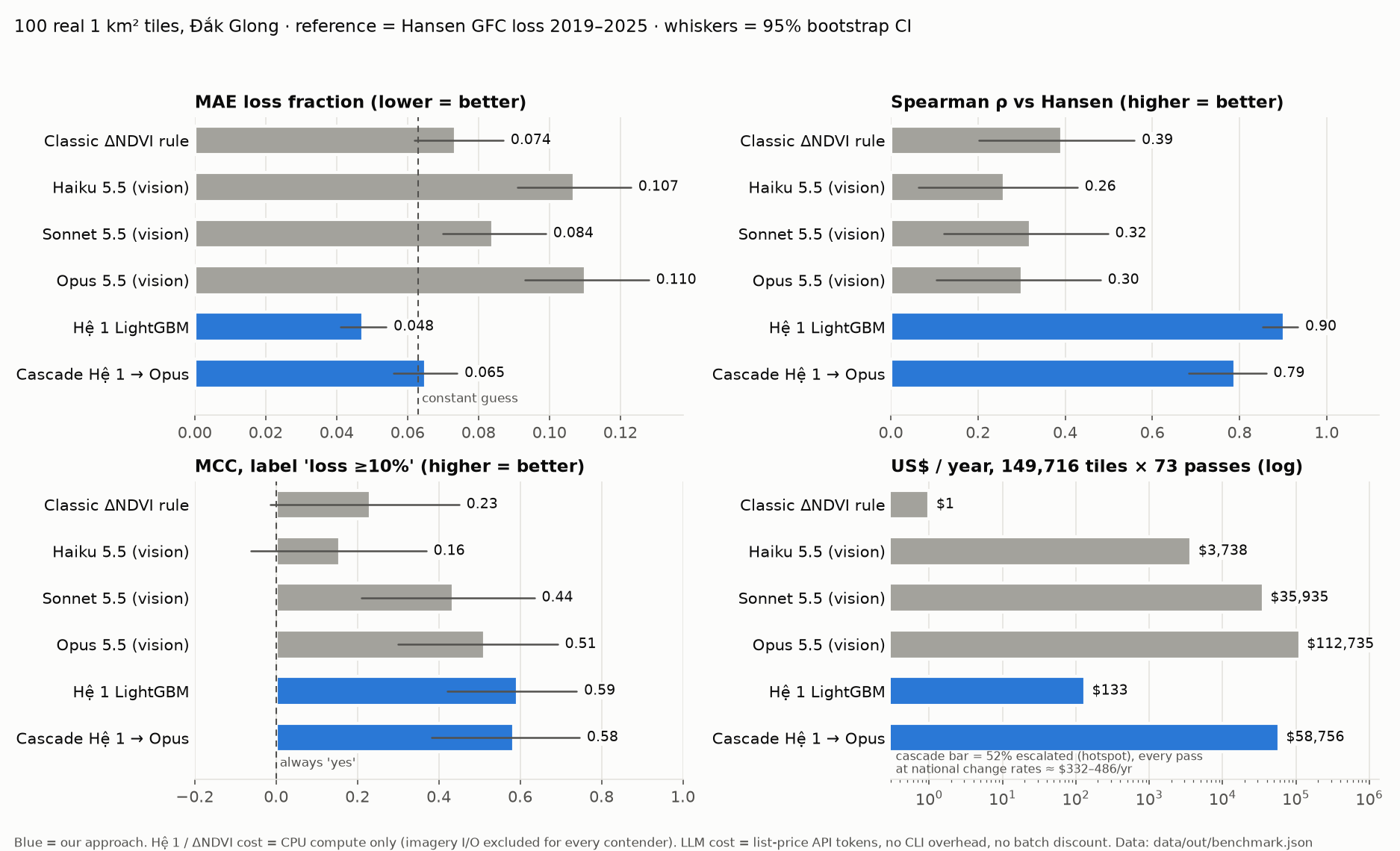
Why the LLMs fail on pixels
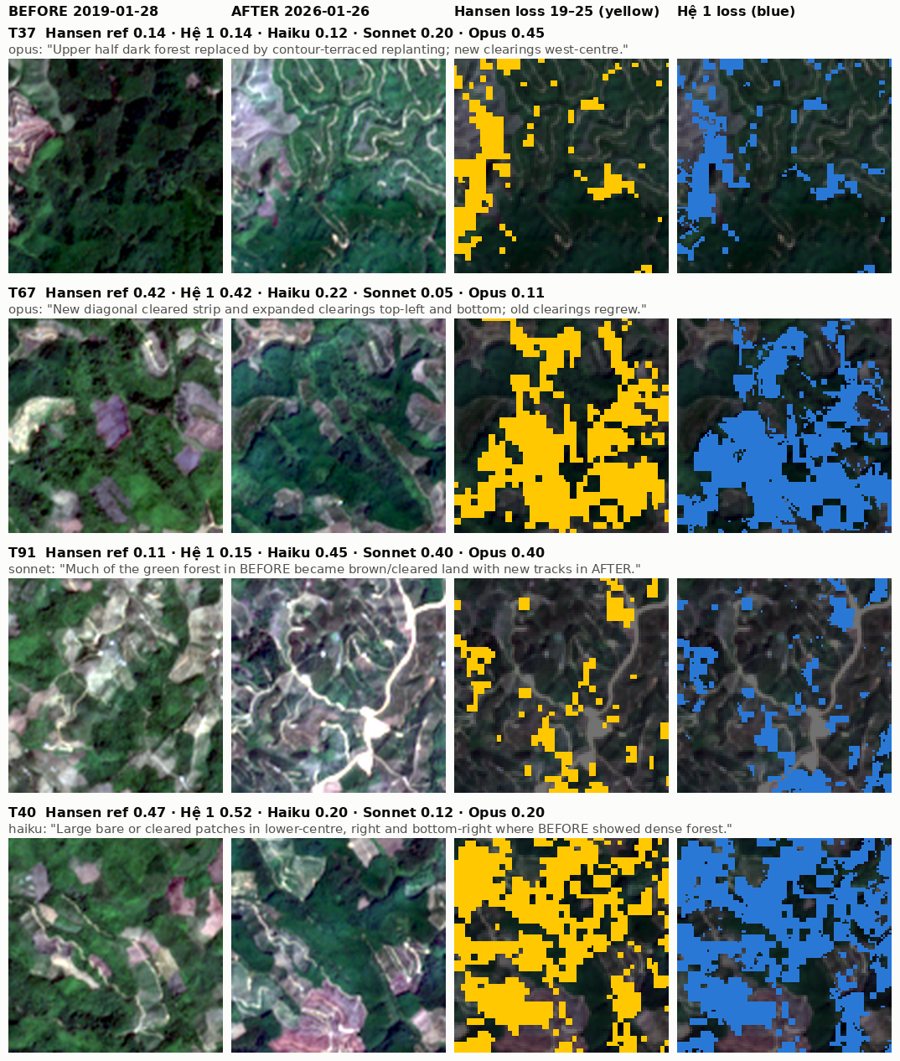
Cascade, speed, area
imgExample tiles: where each contender went wrongdata/out/web/benchmark_examples.png
B · 300 synthetic records: Jev vs Claude vs rules SYNTHETIC records
Can a fast "System 1" decision model triage household acacia harvest records into cần kiểm tra hiện trường vs xếp lưu có lý do? 300 fictional records (85 escalations), an expert rubric frozen before generation, 100 calibration / 200 test records (57 escalations). Thresholds tuned on calibration only, with a missed escalation costing 5× a needless field trip.
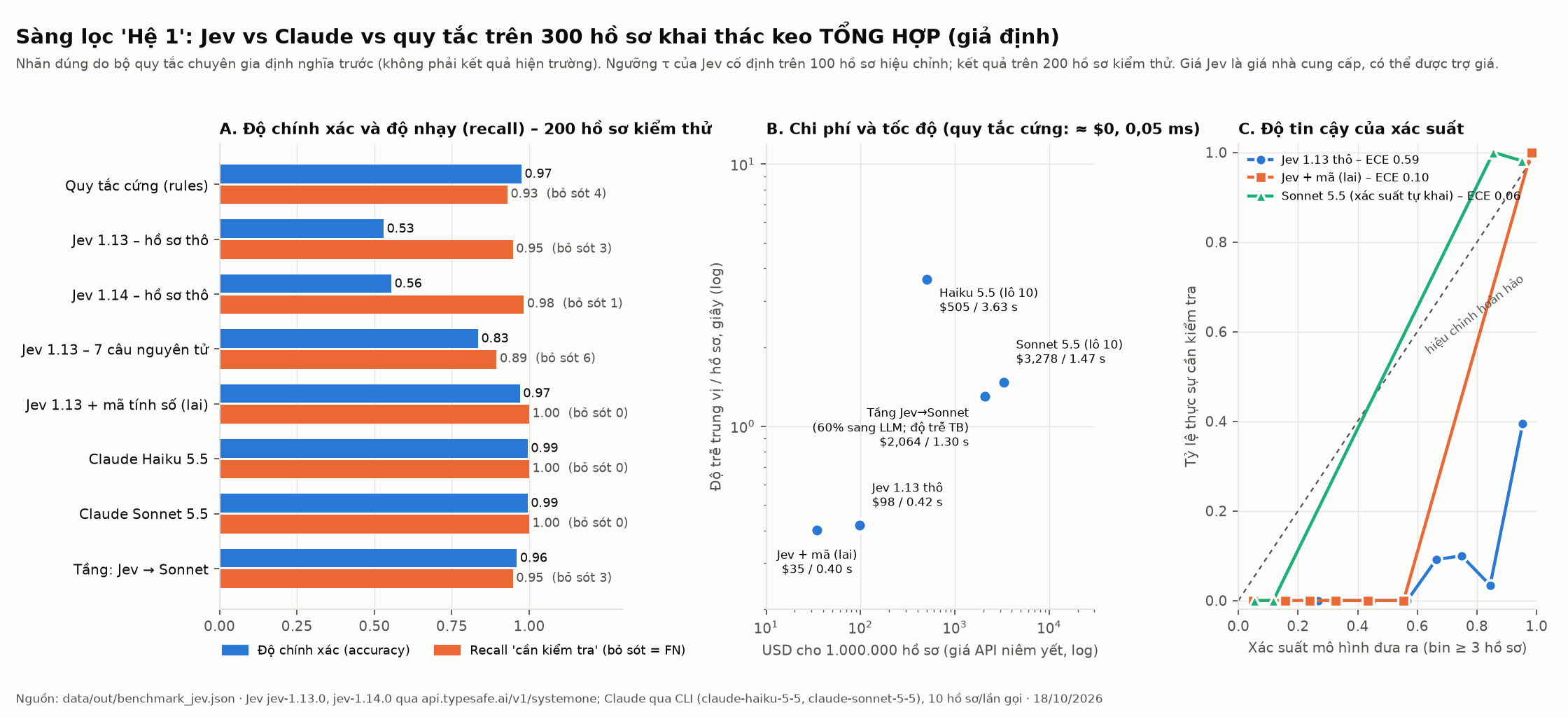
The threshold lesson
What it does not show
Slide 04 là ước tính; slide 07b là đo thật, trên cùng 100 ô 1 km², luật chơi ghi trước khi gọi LLM lần nào. Sai lệch diện tích của Hệ 1 là 0,048; cả ba LLM còn kém một con số đoán cố định. Hệ 1 rẻ hơn 28 đến 850 lần, nhanh hơn 75 đến 170 lần, chạy lại cho kết quả giống hệt.
Chúng tôi nói thẳng: Hệ 1 học từ Hansen nên có lợi khi chấm bằng Hansen, và chênh lệch phát hiện với Sonnet, Opus chưa có ý nghĩa thống kê. Cho LLM xem lại ô lưỡng lự không làm phát hiện tốt hơn. Vì vậy việc của LLM là hồ sơ, và người có thẩm quyền quyết định.
Với hồ sơ, bài học là ngưỡng: mô hình nhanh dùng nguyên hộp gắn cờ gần hết; để đoạn mã kiểm con số, mô hình chỉ đọc ghi chú, thì không bỏ sót hồ sơ nào. Ngưỡng phải hiệu chỉnh trên dữ liệu địa phương.
Sources: benchmark_README.md · benchmark.json H · benchmark_jev_README.md · benchmark_jev.json H (synthetic records; Jev price is a vendor list price) · deck/slides/s07b-bench.js
A mystery with four open loops, three peaks and one line to end on
The arc: "what is" ↔ "what could be"
Duarte's sparkline: slides alternate between today's cold reality (IS, desaturated) and the better possibility (COULD, the three tier colours), ending on a "new bliss". Hover a slide dot to see its role; minutes are targets from the dramaturgy spec.
The central mystery, stage by stage
| Stage | Slide | What happens |
|---|
Four open loops, and where each closes
A loop is a question you plant and promise to answer. Use them for attention, and close every one out loud: an unclosed teaser in front of lawyers reads as hiding something. Click a loop to read the exact opening and closing lines.
Three peaks and the end
The peak-end rule: people remember the most intense moment and the end, not the average. So the intensity is designed, and the end is calm.
Audience-interaction moments
A change of mode every 4–6 minutes. Each moment has an exact line and a graceful fallback.
| Time | Slide | Moment · what to say | Handle it gracefully |
|---|
The 12 psychology principles (plus one)
You do not need to name these on stage (do not lecture psychology). Know why each beat is where it is.
(s08) Vậy câu trả lời thứ nhất cho câu hỏi đầu buổi: chỉ nhìn vệ tinh, không ai biết, kể cả máy.
(s10) Câu trả lời thứ hai: máy không biết; hồ sơ cho biết điểm nào mâu thuẫn; và người có thẩm quyền mới quyết định.
(s16) Máy thấy. Hồ sơ nói. Người quyết định.
Source: research/dramaturgy.md (adds order, suspense, interaction and wording; no new facts). Psychology sources are cited there; several are soft or anecdotal (Cialdini mystery anecdote, Medina 10-minute rule), and the Zeigarnik memory effect did not replicate in the 2025 meta-analysis.
21 cards, one per slide: what to say, when to click, what to avoid
Each card follows the final deck (deck/slides/manifest.js and every slide's notes:): a thumbnail at the slide's last step, what the slide shows, the 1–3 Vietnamese sentences to say, a cue for every click (→ 1, → 2…), the target time, the one number to remember, the likely question with its answer, the pitfall, and links to the glossary terms. Page numbers come from the live manifest (s00 = #1 … s17 = #21; in ?short s04 and s13 disappear and the rest renumber). Tick a slide once you can deliver it without notes.
Plan for 15 minutes; keep the full deck only if the chair confirms 25
The full deck now has – clicks across – slides and runs about – (critique_final §C estimated ≈26:20 for the 17-slide version; s01b, s04b, s07b, the extra s07 step and the s12 ladder add about five minutes). The critique recommends the 15-minute path as the default; we re-planned it for the 21-slide deck to ≈14:55 (rows marked "re-planned" or "our re-plan" differ from the critique). Page numbers below come from the live deck manifest.
| Page full · ?short | Slide | What to do | Time | Clock |
|---|
Pre-flight checklist critique_final §E
Tick as you go; ticks stay in this browser.
Sources: research/critique_final.md §C (15-minute path), §E (risks, checklist) H. Its page numbers predate s07b and are re-computed here from deck/slides/manifest.js. The s07b row and its 0:45 are our suggestion.
Hostile and curious questions, with model answers
Read the question, answer it aloud in Vietnamese, then flip the card (click or Enter) to compare. Three moves that always work: agree with the true part, name the text or the number, turn it into an open question for the pilot.
Test yourself
Instant feedback with the explanation and the source. Your answers are saved in this browser. At the end, review the wrong ones and retry only those. Flashcards drill the numbers you will say aloud.
Pace the talk: full deck or the 15-minute path
Two plans. Full deck: realistic per-slide estimates from critique_final §C (the dramaturgy's 22 minutes is not reachable with 86 clicks and 8 audience moments), re-estimated by us for s01b, s04b, s07, s07b and s12. 15-minute path: the critique's recommended default, re-planned by us to ≈14:55 for the 21-slide deck; s04 and s13 are skipped (as in index.html?short). Start, then press Next (or → / N) as you move on. The clock turns amber at 80% of a slide's budget and red when over. Space = start/pause.
| # | Slide | Plan | Actual | Δ |
|---|
Built from research/BRIEF.md, deck/PLAN.md v3, research/dramaturgy.md, research/{factcheck, proven_solutions, system1, redstone_capabilities, critique_law, critique_tech}.md and data/out/*.json. Synthetic content (the s09/s10 case, toy widgets, illustrative spectra) is labelled amber. Where the research is uncertain, the page says so with M or L.